


- Animals
- Battles-Military
- Biblical Scene
- Bicycle and automobile
- Caricature
- carriages/sledges
- Circus-Acrobatics
- Collage
- Dance of Death
- Erotica
- Fashion
- Figuratives-Portraits
- Genre
- Heraldry
- Hunting
- Incunabula/letters
- Inventions- Craft
- Music-Theater
- Mythology/History
- Numismatics
- Occupation
- Ornaments
- Paintings
- Plants
- Poster
- Seasons
- Ships and aeronautics
- Sports/Games
- Various
Adina Sommer
Antique and Contemporary Art
Winzerer Str. 154
80797 München
telephone
+49 89 304714
business hours:
by appointment



Email



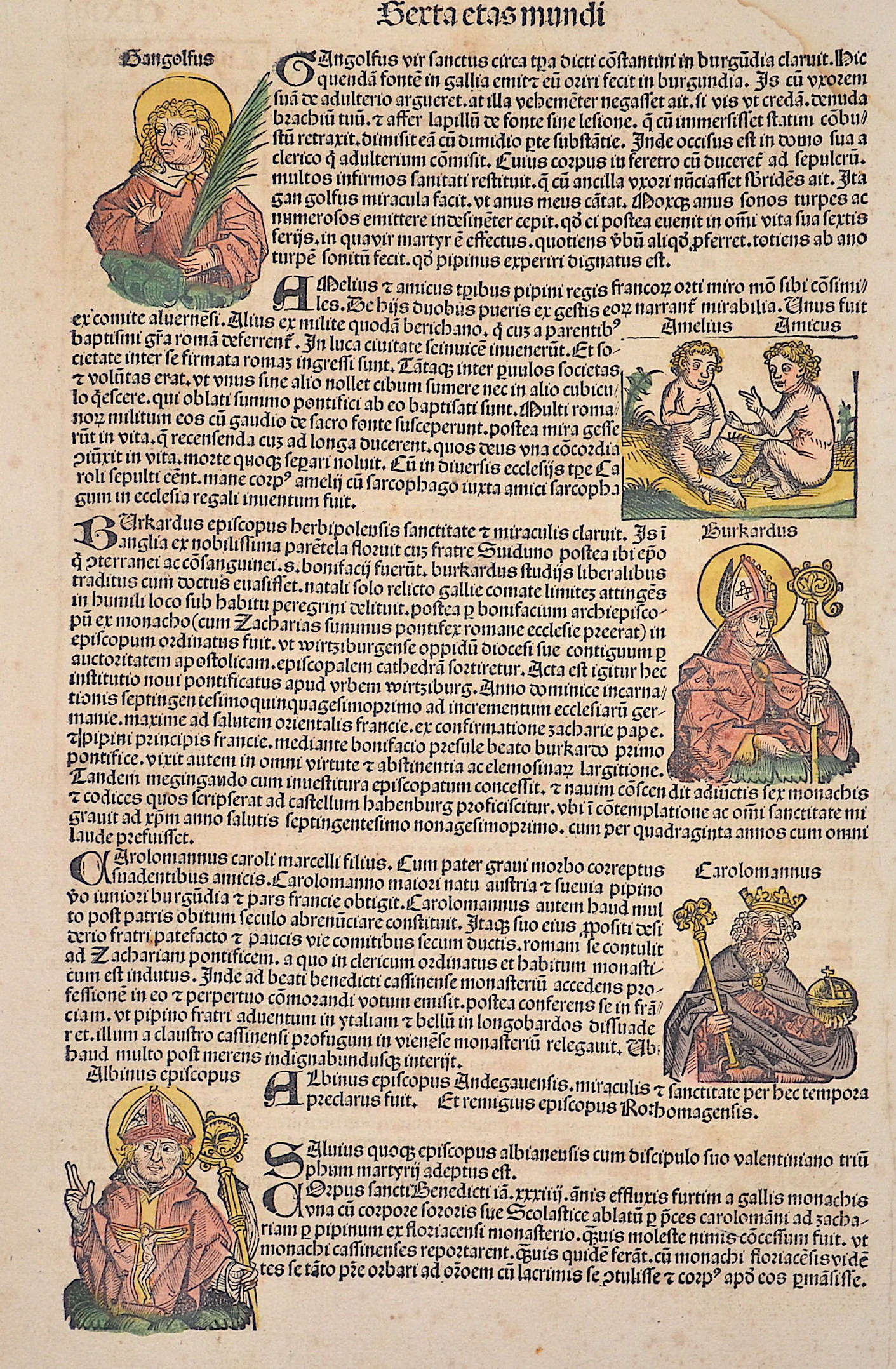
Sexta etas Mundi

| Article ID | DMS0384 |
Title | Sexta etas Mundi |
Description | Representation of different bishops and of Amelius und Amicus / reverse shows different kings. |
| Year | ca. 1495 |
Artist | Schedel Hartman (1440-1515) |
Hartmann Schedel (1440–1515) from Nuremberg is best known for the 1493 publication of the Schedel’s World Chronicle (Liber chronicarum), a universal history featuring 1,809 woodcuts—making it the most richly illustrated book of early printing. The chronicle, written in Latin by Schedel for merchants Sebald Schreyer and Sebastian Kammermeister, was translated into German by Georg Alt and printed by Anton Koberger. The illustrations came from the workshop of Michael Wolgemut and Wilhelm Pleydenwurff. The work covers world history up to 1492/93, divided into eight ages of the world, and draws on numerous sources, including Jacobus Foresta and Enea Silvio Piccolomini. Notably, it features highly accurate city views, many depicted in detail for the first time. Pleydenwurff introduced a new perspective by portraying cities from a fixed viewpoint, emphasizing their unique architectural and landscape features. The project was funded in part by the patron Sebald Schreyer. | |
Historical Description | The Sixth Age of the World in the Schedel’s World Chronicle (Latin: Liber Chronicarum, 1493) describes the period from the birth of Jesus Christ to the present time of the author Hartmann Schedel (that is, up to the late 15th century). It is the last of the six ages of the world according to the medieval Christian concept of history. In the sixth age of the world, Schedel focuses primarily on: the life of Jesus Christ, the spread of Christianity, the apostles and early martyrs the Roman emperors (from Augustus through to Nero and the later emperors), the popes and bishops, the Church Fathers, the origins and development of the Christian Church, medieval emperors and rulers, and the history of Europe up to the 15th century. |
| Place of Publication | Nuremberg |
| Dimensions (cm) | 38 x 23 cm |
| Condition | Perfect condition |
| Coloring | original colored |
| Technique | Woodcut |