


Adina Sommer
Antique and Contemporary Art
Winzerer Str. 154
80797 München
telephone
+49 89 304714
business hours:
by appointment



Email



Der Rhein v. Mannheim bis Cöln.
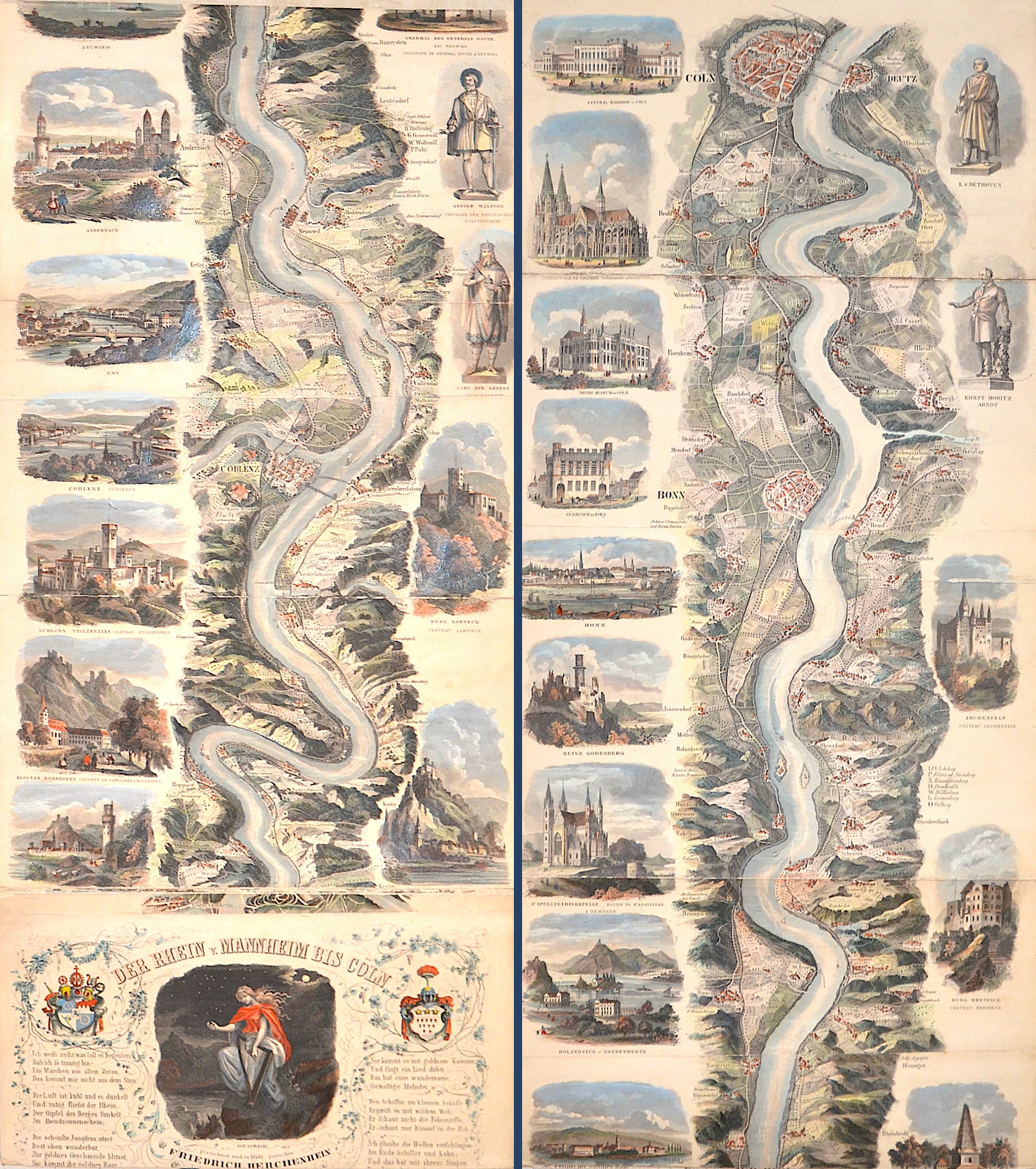

| Article ID | EUD1847 |
Title | Der Rhein v. Mannheim bis Cöln. |
Description | Map shows the course of the Rhine with a bird's eye view of cities from Mannheim to Cologne. To the left and right of the course of the Rhine, 8 statues of famous personalities, 38 views of towns and castles. Below the title cartouche with the Lorelei, on the left and right a coat of arms. Published by D. Kapp. |
| Year | ca. 1860 |
Artist | Herchenhein Friedrich |
Friedrich Herchenhein (active around 1840) was a German lithographer, draughtsman, and publisher, best known for his work in the field of printmaking during the 19th century. His output primarily consists of reproductive prints, including works after paintings, portraits, as well as illustrative plates for books and portfolio publications. Stylistically, his lithographs are characterized by clear line work and carefully modulated tonal gradations, typical of printmaking in the first half of the 19th century. He worked at a time when lithography—a relatively new printing technique—was gaining great importance for the reproduction of images. Herchenhein belonged to a generation of artists and craftsmen who played a significant role in the dissemination of this medium. | |
Historical Description | The Rhine is one of the most important rivers in Europe and has played a significant role in the history and development of the region. It connects several countries, including Switzerland, Germany, France, and the Netherlands. In ancient Europe, the Rhine was an important border, separating the Roman Empire from the Germanic tribes to the north. The Romans used the Rhine as a trade and transport route and built several fortresses along the river to secure their border, including the well-known Limes (border fortifications). The Rhine played a central role in the spread of Roman culture and civilization in the areas along the river. In the Middle Ages, the Rhine was not only an important trade route but also a strategic political point. Cities like Cologne, Mainz, and Speyer along the Rhine developed into important commercial centers. The river was a central part of the Holy Roman Empire and played a key role in the political power dynamics of the region. In the late 18th and early 19th centuries, the Rhine underwent profound changes. During the French Revolution and the Napoleonic Wars, the Rhineland came under French control, and after Napoleon's downfall, it was controlled by Prussia and other German states, becoming an important part of the newly formed German Confederation. In the 19th century, the Rhine experienced significant economic transformation. With the expansion of the railway network and industrialization, the river became an important trade route for raw materials such as coal and iron. Cities like Düsseldorf, Leverkusen, and Mannheim experienced enormous growth and became industrial centers that directly benefited from access to the Rhine. Thus, the course of the Rhine has not only geographical significance but also a profound political, cultural, and economic impact that spans thousands of years. It has shaped both conflict and cooperation and remains a key resource for the countries through which it flows. |
| Place of Publication | Mainz |
| Dimensions (cm) | 230 x 28,5 cm |
| Condition | Some folds partly restored |
| Coloring | colored |
| Technique | Steel engraving |