


Adina Sommer
Antique and Contemporary Art
Winzerer Str. 154
80797 München
telephone
+49 89 304714
business hours:
by appointment



Email



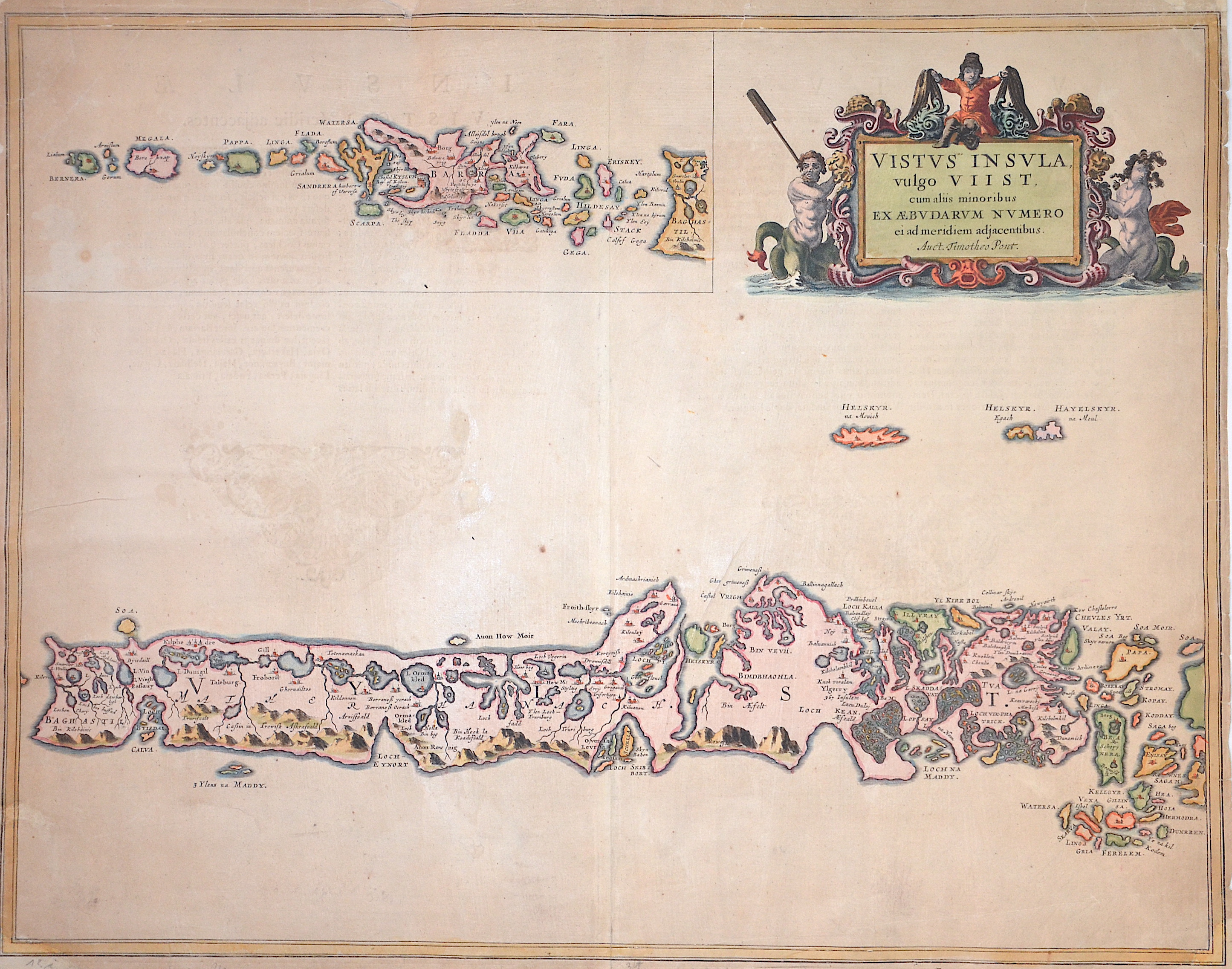
Vistus Insula, vulgo Viist, cum aliis minoribus ex Aebudarum Numero ei ad meridiem adjacentibus.

| Article ID | EUG5529 |
Title | Vistus Insula, vulgo Viist, cum aliis minoribus ex Aebudarum Numero ei ad meridiem adjacentibus. |
Description | The map shows the Scottish islands of the Outer Hebrides, such as the Uist island chain, and a detailed map of Barra and its neighbouring islands. It also features a magnificent title cartouche depicting a fisherman and sea gods. Autor Tomotheo Pont. |
| Year | ca. 1654 |
Artist | Blaeu (1571-1638) |
Joan Guilliemus Blaeu was the eldest son of Willem Janszoon Blaeu (1571-1638), and was probably born in Alkmaar in the province of Noord-Holland in the final years of the 16th century. He was brought up in Amsterdam, and studied law at the University of Leiden before going into partnership with his father in the 1630s. Although his father Willem had cartographic interests, having studied under the Danish astronomer Tycho Brahe and having manufactured globes and instruments, his primary business was as a printer. It was under the control of Joan that the Blaeu printing press achieved lasting fame by moving towards the printing of maps and expanding to become the largest printing press in Europe in the 17th century. By the 1660s the Theatrum Orbis Terrarum (or Atlas Maior as it had became known by this time) had expanded to between 9 and 12 volumes, depending on the language. With over 3,000 text pages and approximately 600 maps, it was the most expensive book money could buy in the later 17th century. The translation of the text from Latin into Dutch, English, German, French, and Spanish for several volumes created enormous work for those involved in typography and letterpress activities. It is estimated that over 80 men must have been employed full-time in the Blaeu printing house in Bloemgracht, not including engravers who worked elsewhere, with over 15 printing presses running simultaneously, and in 1667 a second press was acquired at Gravenstraat. At the same time as producing the Atlas Maior, Blaeu was also publishing town plans of Italy, maps for globes, and other volumes. At its peak the Blaeu press managed to produce over 1 million impressions from 1,000 copper plates within four years. | |
Historical Description | Beginning in the sixth century, the area that is now Scotland was divided into three areas: Pictland, a patchwork of small lordships in central Scotland. The Kingdom of Scotland emerged as an independent sovereign state in the European Early Middle Ages and continued to exist until 1707. By inheritance in 1603, James VI of Scotland became king of England and Ireland, thus forming a personal union of the three kingdoms. Scotland subsequently entered into a political union with the Kingdom of England on 1 May 1707 to create the new Kingdom of Great Britain.The Treaty of Eternal Peace was signed in 1502 by James IV, Scotland and Henry VII, England. James married Henry's daughter Margaret Tudor. James marched into England under the Auld Alliance to support France and died in Flodden in 1513 as the last British monarch in battle. In 1560 the Edinburgh Treaty ended the Anglo-French conflict and recognized Protestant Elizabeth I as Queen of England. The Scottish Parliament met and immediately accepted the Scottish confession, which signaled the sharpness of the Scottish Reformation and thus the break with papal authority and Catholic teaching. Catholic Mary, Queen of Scots, had to abdicate in 1567.With trade tariffs with England abolished, trade blossomed, especially with Colonial America. The clippers belonging to the Glasgow Tobacco Lords were the fastest ships on the route to Virginia. Until the American War of Independence in 1776, Glasgow was the world's premier tobacco port, dominating world trade.[60] The disparity between the wealth of the merchant classes of the Scottish Lowlands and the ancient clans of the Scottish Highlands grew, amplifying centuries of division.The deposed Jacobite Stuart claimants had remained popular in the Highlands and north-east, particularly amongst non-Presbyterians, including Roman Catholics and Episcopalian Protestants. However, two major Jacobite risings launched in 1715 and 1745 failed to remove the House of Hanover from the British throne. The threat of the Jacobite movement to the United Kingdom and its monarchs effectively ended at the Battle of Culloden, Great Britain's last pitched battle. The Battle of Altimarlach in 1680 was the last significant clan battle fought between highland clans. In 1706, the Treaty of Union was agreed between representatives of the Scots Parliament and the Parliament of England. The following year, twin Acts of Union were passed by both parliaments to create the united Kingdom of Great Britain with effect from 1707 with popular opposition and anti-union riots in Edinburgh, Glasgow, and elsewhere. |
| Place of Publication | Amsterdam |
| Dimensions (cm) | 45 x 57,5 cm |
| Condition | Left and right lower corners replaced, tears restored, browned |
| Coloring | original colored |
| Technique | Copper print |