


Adina Sommer
Antique and Contemporary Art
Winzerer Str. 154
80797 München
telephone
+49 89 304714
business hours:
by appointment



Email



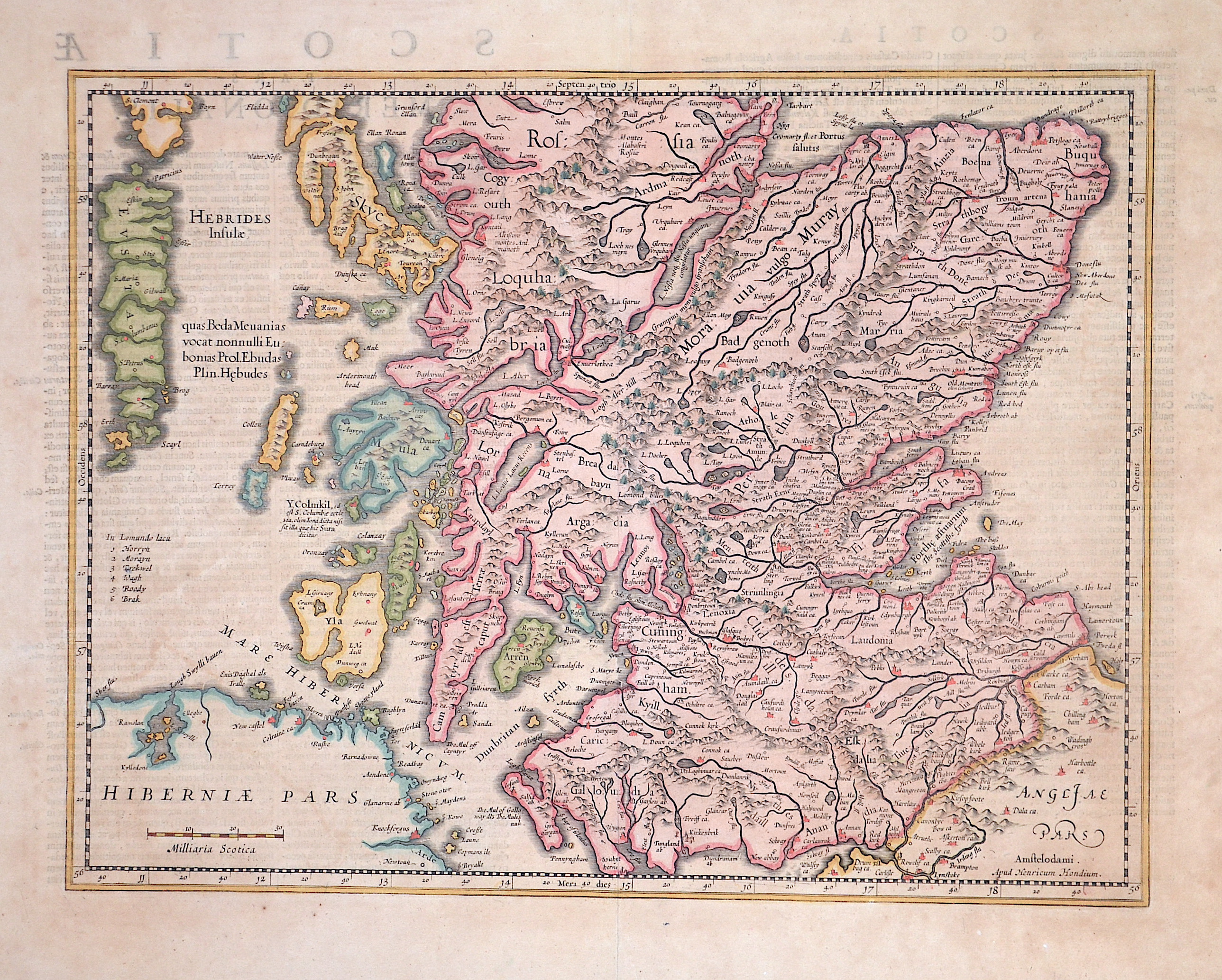
Scotiae pars Meridionalis.

| Article ID | EUG5528 |
Title | Scotiae pars Meridionalis. |
Description | Map shows southern Scotland with the Inner Hebrides. Reverse side with Latin text. |
| Year | ca. 1620 |
Artist | Hondius (1597-1650) |
Jodocus Hondius (1563 –1612) was a Dutch engraver, and cartographer. He is best known for his early maps of the New World and Europe, for re-establishing the reputation of the work of Gerard Mercator, and for his portraits of Francis Drake. He helped establish Amsterdam as the center of cartography in Europe in the 17th century. He was born in Wakken and grew up in Ghent. In his early years he established himself as an engraver, instrument maker and globe maker. In 1584 he moved to London to escape religious difficulties in Flanders. While in England, Hondius was instrumental in publicizing the work of Francis Drake, who had made a circumnavigation of the world in the late 1570s. In particular, in 1589 Hondius produced a now famous map of the bay of New Albion, where Drake briefly established a settlement on the west coast of North America. Hondius' map was based on journal and eyewitness accounts of the trip and has long fueled speculation about the precise location of Drake's landing, which has not yet been firmly established by historians. Hondius is also thought to be the artist of several well-known portraits of Drake that are now in the National Portrait Gallery in London. In 1593 he moved to Amsterdam, where he remained until the end of his life. In co-operation with the Amsterdam publisher Cornelis Claesz. in 1604 he purchased the plates of Gerard Mercator's Atlas from Mercator's grandson. Mercator's work had languished in comparison to the rival Theatrum Orbis Terrarum by Ortelius. Hondius republished Mercator's work with 36 additional maps, including several which he himself had produced. Despite the addition of his own contributions, Hondius gave Mercator full credit as the author of the work, listing himself as the publisher. Hondius' new edition of Mercator's work was a great success, selling out after a year. Hondius later published a second edition, as well as a pocket version Atlas Minor. The maps have since become known as the ""Mercator/Hondius series"" . In the French edition of the Atlas Minor we find one of the first instances of a thematic map using map symbols. This is a map entitled Designatio orbis christiani (1607) showing the dispersion of major religions. Between 1605 and 1610 he was employed by John Speed to engrave the plates for Speed's The Theatre of the Empire of Great Britaine. Hondius died, aged 48, in Amsterdam. After his death, his publishing work in Amsterdam was continued by his widow, two sons, Jodocus II and Henricus, and son-in-law Johannes Janssonius, whose name appears on the Atlas as co-publisher after 1633. Eventually, starting with the first 1606 edition in Latin, about 50 editions of the Atlas were released in the main European languages. In the Islamic world, the atlas was partially translated by the Turkish scholar Katip Çelebi. The series is sometimes called the ""Mercator/Hondius/Janssonius"" series because of Janssonius's later contributions. | |
Historical Description | Beginning in the sixth century, the area that is now Scotland was divided into three areas: Pictland, a patchwork of small lordships in central Scotland. The Kingdom of Scotland emerged as an independent sovereign state in the European Early Middle Ages and continued to exist until 1707. By inheritance in 1603, James VI of Scotland became king of England and Ireland, thus forming a personal union of the three kingdoms. Scotland subsequently entered into a political union with the Kingdom of England on 1 May 1707 to create the new Kingdom of Great Britain.The Treaty of Eternal Peace was signed in 1502 by James IV, Scotland and Henry VII, England. James married Henry's daughter Margaret Tudor. James marched into England under the Auld Alliance to support France and died in Flodden in 1513 as the last British monarch in battle. In 1560 the Edinburgh Treaty ended the Anglo-French conflict and recognized Protestant Elizabeth I as Queen of England. The Scottish Parliament met and immediately accepted the Scottish confession, which signaled the sharpness of the Scottish Reformation and thus the break with papal authority and Catholic teaching. Catholic Mary, Queen of Scots, had to abdicate in 1567.With trade tariffs with England abolished, trade blossomed, especially with Colonial America. The clippers belonging to the Glasgow Tobacco Lords were the fastest ships on the route to Virginia. Until the American War of Independence in 1776, Glasgow was the world's premier tobacco port, dominating world trade.[60] The disparity between the wealth of the merchant classes of the Scottish Lowlands and the ancient clans of the Scottish Highlands grew, amplifying centuries of division.The deposed Jacobite Stuart claimants had remained popular in the Highlands and north-east, particularly amongst non-Presbyterians, including Roman Catholics and Episcopalian Protestants. However, two major Jacobite risings launched in 1715 and 1745 failed to remove the House of Hanover from the British throne. The threat of the Jacobite movement to the United Kingdom and its monarchs effectively ended at the Battle of Culloden, Great Britain's last pitched battle. The Battle of Altimarlach in 1680 was the last significant clan battle fought between highland clans. In 1706, the Treaty of Union was agreed between representatives of the Scots Parliament and the Parliament of England. The following year, twin Acts of Union were passed by both parliaments to create the united Kingdom of Great Britain with effect from 1707 with popular opposition and anti-union riots in Edinburgh, Glasgow, and elsewhere. |
| Place of Publication | Amsterdam |
| Dimensions (cm) | 35 x 45,5 cm |
| Condition | Browned, two tearsat the bottom expertly restored |
| Coloring | original colored |
| Technique | Copper print |