


Adina Sommer
Antique and Contemporary Art
Winzerer Str. 154
80797 München
telephone
+49 89 304714
business hours:
by appointment



Email



Pannonia, Moesia, Dacia, Ilyricum
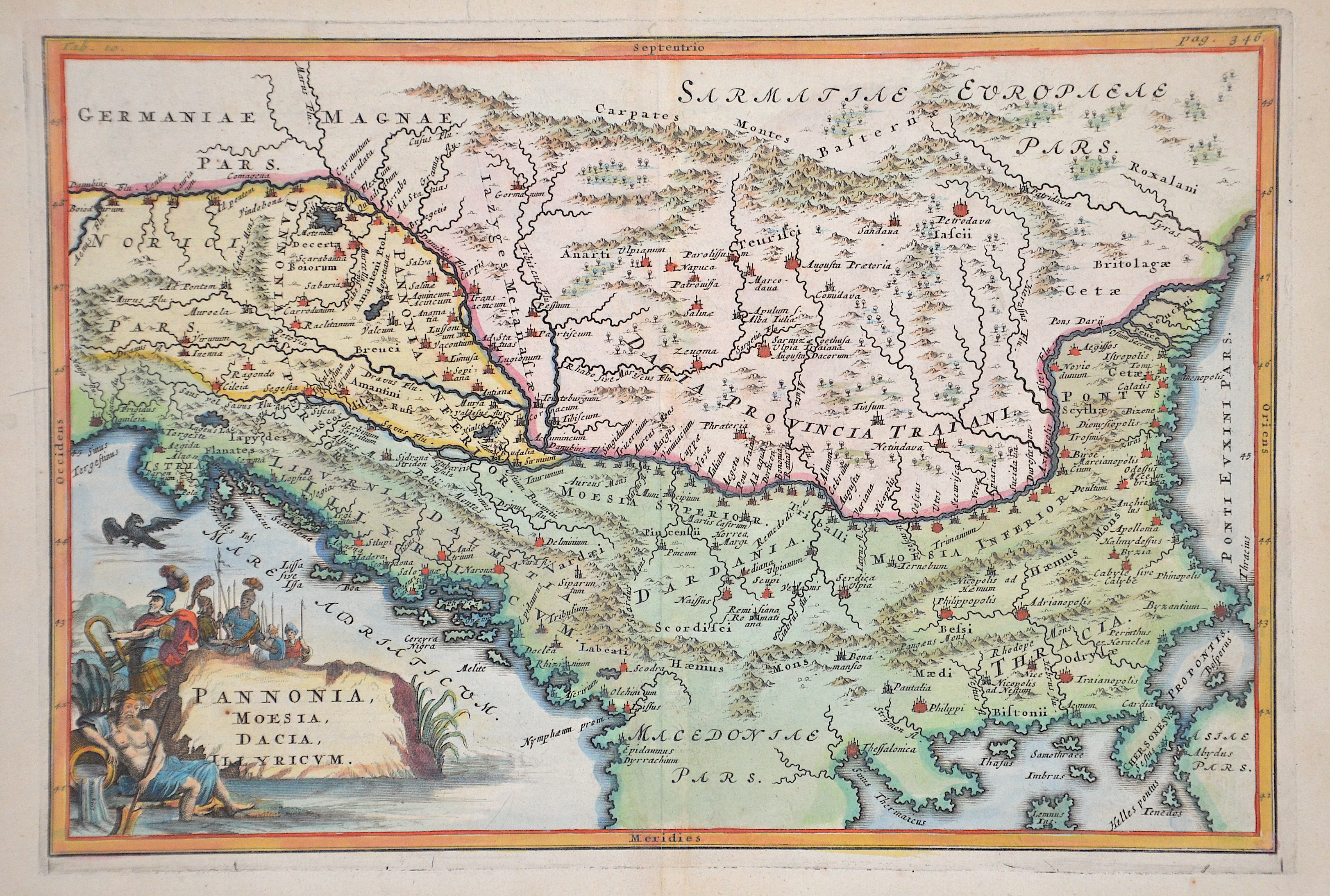

| Article ID | EUY2661 |
Title | Pannonia, Moesia, Dacia, Ilyricum |
Description | Map shows Kroatia, Dalmatia and Slovenia, partly Romania |
| Year | ca. 1690 |
Artist | Scherer (1628-1704) |
Heinrich Scherer was a German Jesuit and cartographer. He was born in 1628 and later joined the Jesuit order. There he received his education in mathematics, astronomy, and geography. These subjects were very important for understanding the world at that time. Scherer worked as a teacher of mathematics and astronomy, mainly in Ingolstadt. Besides teaching, he also drew maps of countries and the world. His maps were not only accurate but were also meant to teach knowledge and explain Christian ideas. For this reason, many of his maps are artistic and symbolic. His most famous work is called “Atlas novus.” It contains maps of the whole world and of the individual continents. Heinrich Scherer died in 1704. Today, his maps are important for understanding how people in the 17th century viewed the world. | |
Historical Description | In the historical sense, Eastern Europe refers to Ukraine, the European part of Russia, Belarus and the Republic of Moldova. Occasionally, the Caucasian countries of Georgia, Armenia and, conditionally, Azerbaijan are also seen as part of Eastern Europe. By Christian Giordano and other scholars, one of the six historical regions of Europe is called "Eastern Europe." The Eastern European countries are historically and culturally largely influenced by the Orthodox Church (Islamic Azerbaijan excepted) and were - in contrast to the Ottoman-dominated Balkans - under the rule of the Russian Empire. Like the Balkan countries, the countries of Eastern Europe were for a long time backward agricultural states (cf.: Intermediate Europe) and had no or only a limited share in the social developments of the Renaissance, Reformation and Enlightenment of the Western world. |
| Place of Publication | Munich |
| Dimensions (cm) | 20 x 30,5 |
| Condition | Very good |
| Coloring | original colored |
| Technique | Copper print |