


Adina Sommer
Antique and Contemporary Art
Winzerer Str. 154
80797 München
telephone
+49 89 304714
business hours:
by appointment



Email



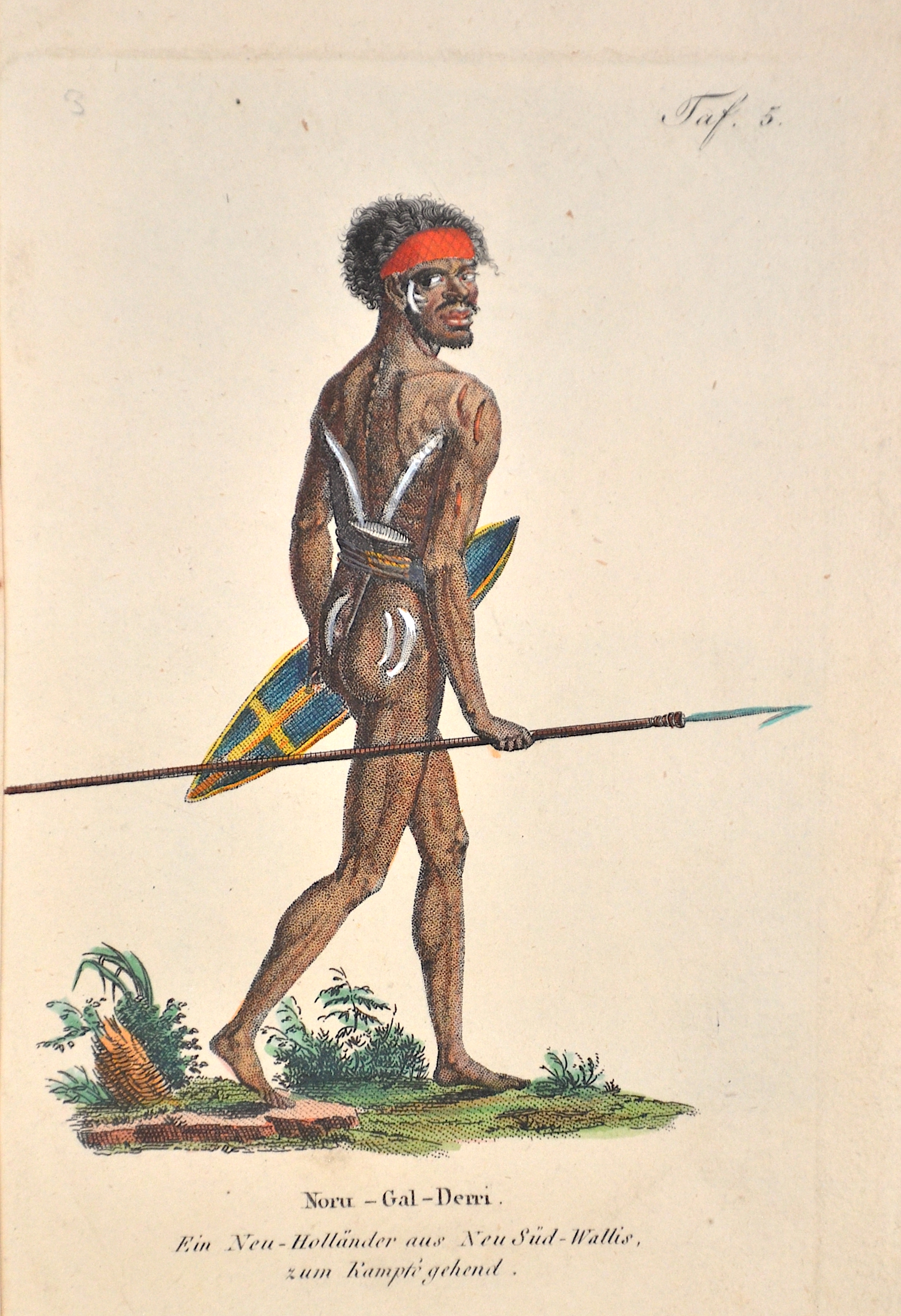
Noru-Gal-Derri. Ein Neu-Holländer aus Neu Süd-Wallis, zum Kampfe gehend. Taf. 5

| Article ID | OZ0564 |
Title | Noru-Gal-Derri. Ein Neu-Holländer aus Neu Süd-Wallis, zum Kampfe gehend. Taf. 5 |
Description | The image shows an indigenous warrior (Aboriginal) from New South Wales in Australia.From ALLGEMEINE WELTKUNDE ODER ENCYKLOPÄDIE FÜR GEOGRAPHIE, STATISTIK UND... |
| Year | ca. 1720 |
Artist | Galetti (1750-1828) |
Johann Georg August Galletti (1750–1828), Gotha, was a German historian, educator, writer, and geographer, and the author of numerous historically and educationally significant works of his time. He worked primarily as a teacher at the Gymnasium in Gotha and became known for his humorous, often unintentionally comical remarks, which later circulated widely in collections of anecdotes known as the “Gallettiana.” Despite the mockery he attracted, Galletti was a learned and dedicated teacher who wrote historical and geographical textbooks and had a considerable influence on the education of his era. From 1778 to 1819, he served as a professor of Latin and German at the Gotha Gymnasium Illustre, later becoming a professor of history and geography. In 1816, he was appointed ducal councillor (Hofrat) and “historiographer of the Duchy of Gotha,” before retiring in 1819. | |
Historical Description | The first meeting between the native people and the British occurred on 29 April 1770 when Lieutenant James Cook landed at Botany Bay on the Kurnell Peninsula and encountered the Gweagal clan.He noted in his journal that they were confused and somewhat hostile towards the foreign visitors.Cook was on a mission of exploration and was not commissioned to start a settlement. He spent a short time collecting food and conducting scientific observations before continuing further north along the east coast of Australia and claiming the new land he had discovered for Britain. Prior to the arrival of the British there were 4,000 to 8,000 native people in Sydney from as many as 29 different clans. The earliest British settlers called the natives Eora people. ;Eora; is the term the indigenous population used to explain their origins upon first contact with the British. Its literal meaning is ;from this place;. Sydney Cove from Port Jackson to Petersham was inhabited by the Cadigal clan.The principal language groups were Darug, Guringai, and Dharawal. The earliest Europeans to visit the area noted that the indigenous people were conducting activities such as camping and fishing, using trees for bark and food, collecting shells, and cooking fish. |
| Place of Publication | Germany |
| Dimensions (cm) | 17 x 11,8 cm |
| Condition | Trimmed |
| Coloring | original colored |
| Technique | Copper print |