


Adina Sommer
Antique and Contemporary Art
Winzerer Str. 154
80797 München
telephone
+49 89 304714
business hours:
by appointment



Email



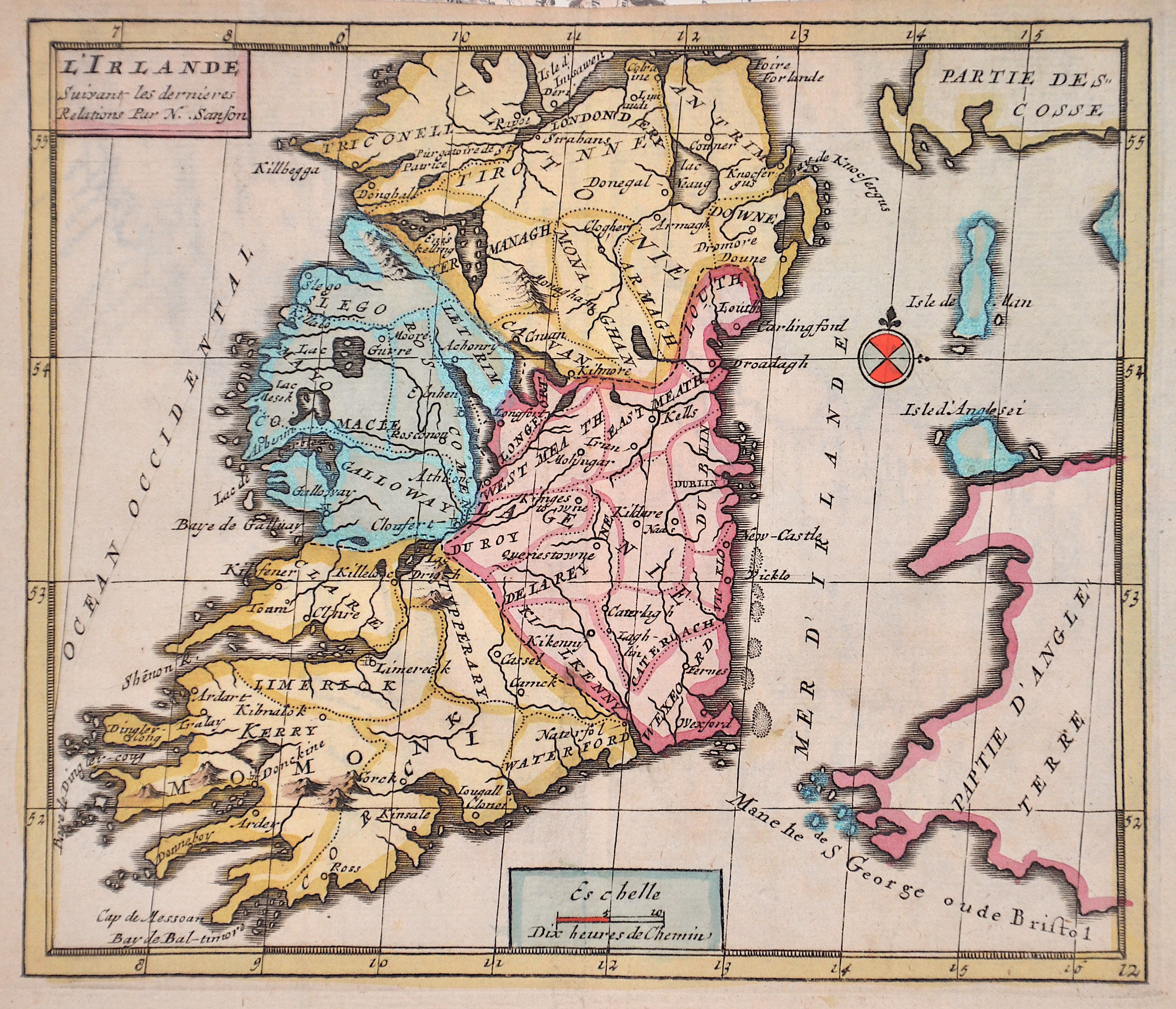
L’Irlande Suivant les dernieres Relations

| Article ID | EUG5531 |
Title | L’Irlande Suivant les dernieres Relations |
Description | Map shows all of Ireland with a compass rose and a mile indicator. |
| Year | ca. 1690 |
Artist | Sanson (1600-1667) |
Nicolas Sanson (1600–1667) was a French cartographer, termed by some the creator of French geography, in which he's been called the father of French cartography. Active from 1627, Sanson issued his first map of importance, the ""Postes de France"", which was published by Melchior Tavernier in 1632. After publishing several general atlases himself he became the associate of Pierre Mariette, a publisher of prints. In 1647 Sanson accused the Jesuit Philippe Labbe of plagiarizing him in his Pharus Galliae Antiquae; in 1648 he lost his eldest son Nicolas, killed during the Fronde. Among the friends of his later years was the great Condé. He died in Paris on 7 July 1667. Two younger sons, Adrien (d. 1708) and Guillaume (d. 1703), succeeded him as geographers to the king. In 1692 Hubert Jaillot collected Sanson's maps in an Atlas nouveau. See also the 18th century editions of some of Sanson's works on Delamarche under the titles of Atlas de géographie ancienne and Atlas britannique; and the Catalogue des cartes et livres de géographie de Sanson (1702). | |
Historical Description | In the Roman Empire, Ireland was known as Hiberna, the classical latin name. The Norman invasion of the late 12th century marked the beginning of more than 800 years of direct English rule and, later, British involvement in Ireland. Attempts to either conquer or assimilate the Irish lordships into the Kingdom of Ireland provided the initial impetus for a series of Irish military campaigns between 1534 and 1603. This period was marked by a Crown policy of plantation, involving the arrival of thousands of English and ScottishProtestant settlers, and the consequent displacement of the pre-plantation Catholic landholders. As the military and political defeat of Gaelic Ireland became more pronounced in the early seventeenth century, sectarian conflict became a recurrent theme in Irish history. |
| Place of Publication | Paris |
| Dimensions (cm) | 16,5 x 19,4 cm |
| Condition | Perfect condition |
| Coloring | original colored |
| Technique | Copper print |