


Adina Sommer
Antique and Contemporary Art
Winzerer Str. 154
80797 München
telephone
+49 89 304714
business hours:
by appointment



Email



Alexandria
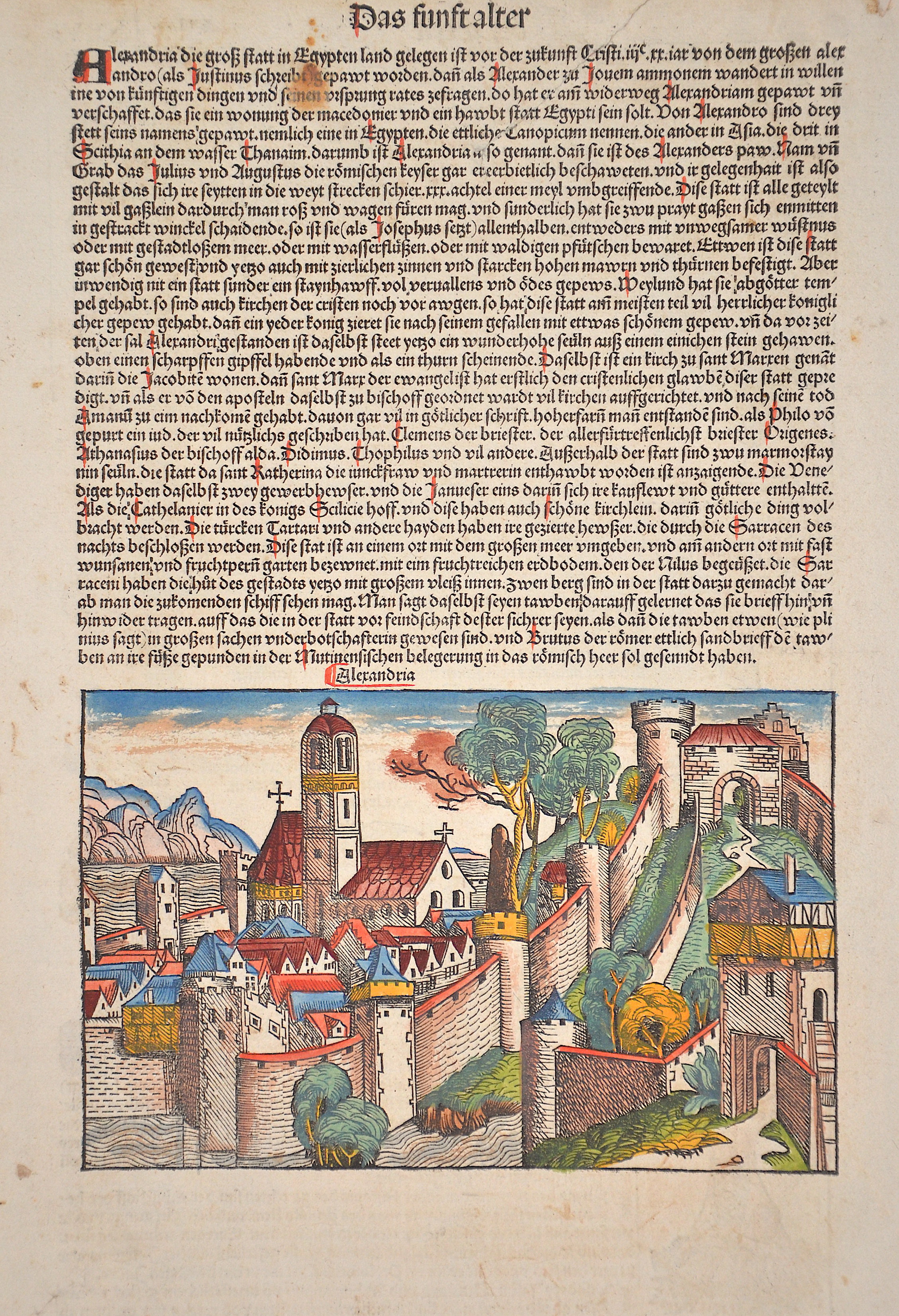

| Article ID | AF0289 |
Title | Alexandria |
Description | Map shows the city of Alexandria, on reverse representation 11 philosophs and kings. |
| Year | ca. 1495 |
Artist | Schedel (1440-1515) |
Hartmann Schedel (1440–1515) from Nuremberg is best known for the 1493 publication of the Schedel’s World Chronicle (Liber chronicarum), a universal history featuring 1,809 woodcuts—making it the most richly illustrated book of early printing. The chronicle, written in Latin by Schedel for merchants Sebald Schreyer and Sebastian Kammermeister, was translated into German by Georg Alt and printed by Anton Koberger. The illustrations came from the workshop of Michael Wolgemut and Wilhelm Pleydenwurff. The work covers world history up to 1492/93, divided into eight ages of the world, and draws on numerous sources, including Jacobus Foresta and Enea Silvio Piccolomini. Notably, it features highly accurate city views, many depicted in detail for the first time. Pleydenwurff introduced a new perspective by portraying cities from a fixed viewpoint, emphasizing their unique architectural and landscape features. The project was funded in part by the patron Sebald Schreyer. | |
Historical Description | The first settlement of today's city area probably took place between 2700 and 2200 BC.[331 BC The general and Macedonian king Alexander the Great founded Alexandria on the site of the Egyptian settlement of Rachotis (Raqote), whereby he himself determined the location of the marketplace and the main traffic axes. Alexandria was built according to plans by the Greek architect Deinokrates. Only after Alexander's death, under Ptolemy II between 285 and 246 BC, was Alexandria completed to the planned extent, but between 320 and 311 it became the residence city of the Ptolemaic kings and retained this function until the end of the Ptolemaic Empire. The polis of Alexandria was not formally considered part of Egypt, but was always referred to as “Alexandria near Egypt” for centuries; this only changed in Roman times. n its heyday from 300 BC to 400 AD, Alexandria was an economic, intellectual and political center of the eastern Mediterranean, even under Roman rule. Famous buildings such as the Pharos lighthouse, the Museion with its great library and numerous theaters, palaces and temples made the city famous throughout the ancient Mediterranean. Around 30 BC, the city was conquered by Octavian and the city - like all of Egypt - was incorporated into the Imperium Romanum. After the conquest of Egypt by the Persian Sassanid Empire in 619, Ostrom/Byzantium was able to regain the land in 629, but in 642 after the conquest of Egypt, the city became a part of the Roman Empire. The anarchic conditions in the Middle Ages are reflected in the changing dynasties that were the sultans of Egypt at the time. At the same time, Alexandria was an intellectual center for Muslim scholars from East and West. The Mamluks retained the internal administration of Egypt even after the Ottoman conquest in 1517, but the expansion of the Ottoman Empire made European trade with India and China more difficult, leading to the exploration and establishment of the sea route to India. With the loss of the lucrative land transportation from the Mediterranean to the Red Sea, the importance of the port of Alexandria diminished. In addition, Egypt as an Ottoman province fell into general stagnation under Mamluk rule. As a result, the former metropolis of Alexandria became an insignificant small town. Napoleon Bonaparte landed in Alexandria in 1798 during his Egyptian expedition, conquered the city and defeated the Mamluks. After the weakness of the Mamelukes and the Ottoman Empire had become apparent, Muhammad Ali Pasha, commander of the Ottoman Empire's Albanian Guard in Egypt, seized control of the province. Under his rule, Egypt's first modern shipyard was built at the port of Alexandria. |
| Place of Publication | Nuremberg |
| Dimensions (cm) | 34 x 22,5 cm |
| Condition | Tear on upper margin perfectly restored |
| Coloring | original colored |
| Technique | Woodcut |