


Adina Sommer
Antique and Contemporary Art
Winzerer Str. 154
80797 München
telephone
+49 89 304714
business hours:
by appointment



Email



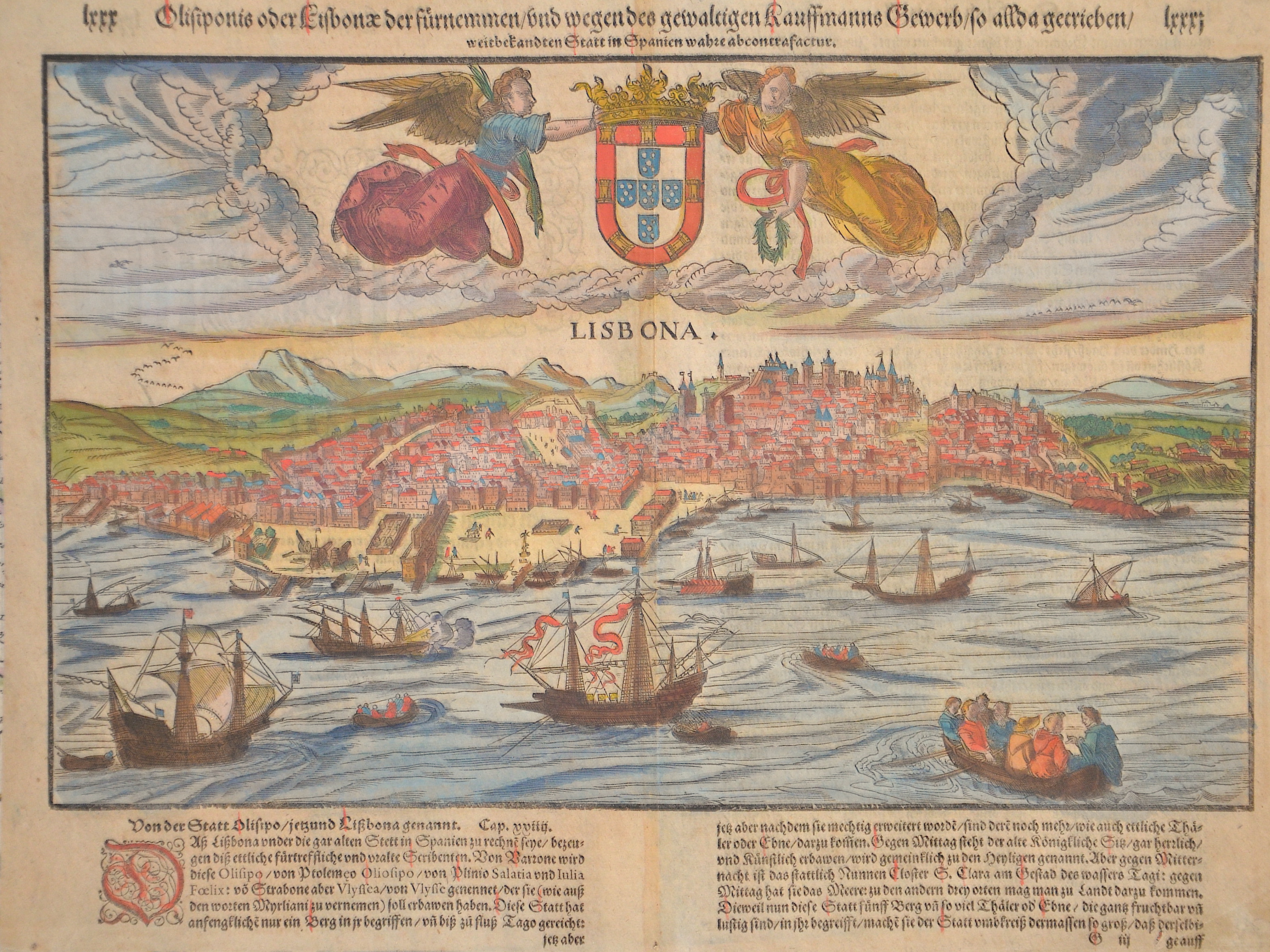
Olisiponis oder Lisbonae der fürnehmen, und wegen des gewaltigen Kauffmans Gewerb, so all da getrieben, weitbekandten Statt in Spanien.

| Article ID | EUE636 |
Title | Olisiponis oder Lisbonae der fürnehmen, und wegen des gewaltigen Kauffmans Gewerb, so all da getrieben, weitbekandten Statt in Spanien. |
Description | Magnificent bird's-eye view of Lisbon in Portugal. With ships offshore, view of the harbour and, above the title, the Portuguese coat of arms held by two angels. |
| Year | ca. 1550 |
Artist | Münster Sebastian (1489-1552) |
Sebastian Münster (1489–1552) was a leading Renaissance cosmographer. His most famous work, the Cosmographia (1544), was a comprehensive description of the world with 24 maps, based on research dating back to 1528. Continuously revised, the 1550 edition already included many new maps. It was the first scientific yet accessible world description published in German, illustrated with numerous woodcuts by artists such as Hans Holbein the Younger. Between 1544 and 1650, the Cosmographia appeared in 46 editions (27 in German) and was translated into several languages. Münster’s work combined the knowledge of scholars, artists, and travelers and remained influential long after his death. | |
Historical Description | Saint Lisbon is one of the oldest cities in Europe, with a history of settlement by Phoenicians, Romans, and Moors. In 1147, King Afonso I captured the city during the Christian Reconquista. During the fifteenth and sixteenth centuries, Lisbon became Portugal's principal port and a leading center of European maritime trade in the Age of Discovery. The devastating earthquake of 1755 destroyed much of the city, which was subsequently rebuilt under the direction of the Marquis of Pombal according to modern urban planning principles. Today, Lisbon is the capital of Portugal and the country's political, economic, and cultural center. |
| Place of Publication | Basle |
| Dimensions (cm) | 29,5 x 37,5 cm |
| Condition | Perfect condition |
| Coloring | original colored |
| Technique | Woodcut |