


Adina Sommer
Antique and Contemporary Art
Winzerer Str. 154
80797 München
telephone
+49 89 304714
business hours:
by appointment



Email



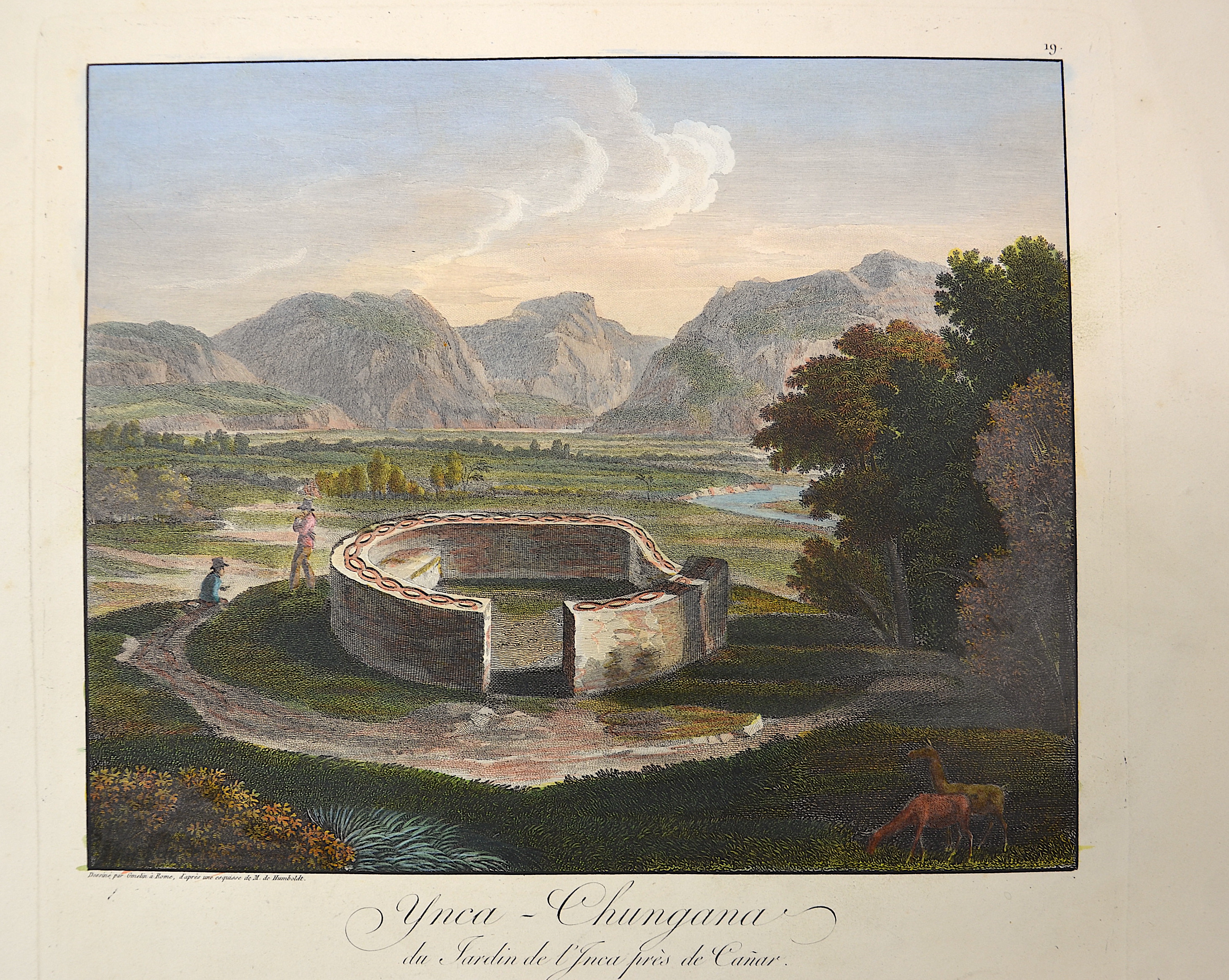
Ynca-Chungana du Jardin de l’Jnea pres de Canar.

| Article ID | AMS1602 |
Title | Ynca-Chungana du Jardin de l’Jnea pres de Canar. |
Description | Shows an archaeological site of the Incas in the province of Cañar in Ecuador. Ynca-Chungana, from the Inca garden near Canar, drawn by Gmelin, engraved by Morel, from ‘Vues des Cordillères et Monumens des Peuples Indigènes de l'Amérique’ by Alexander von Humboldt and Aime Bonpland . |
| Year | ca. 1810 |
Artist | Humboldt von Alexander Friedrich (1769-1859) |
Alexander von Humboldt (1769–1859) was a German naturalist, geographer, and explorer, and is regarded as one of the most distinguished polymaths of the 19th century. During his great expedition to the Americas from 1799 to 1804, he explored extensive regions of South and Central America together with Aimé Bonpland. Among other subjects, they investigated volcanoes, mountain ranges, climate, vegetation, and the geological conditions of the Andes. Humboldt combined precise scientific measurements with striking and highly detailed landscape depictions. His observations of Pichincha and other volcanoes in Ecuador became an important part of his extensive scientific publications. He is particularly renowned for his work Vues des Cordillères et Monumens des Peuples Indigènes de l’Amérique, which contains numerous landscapes, volcanoes, maps, and cultural and historical records from his American expedition. Humboldt’s holistic approach to the natural world had a lasting influence on the development of modern geography, geology, climatology, and ecology. | |
Historical Description | Ingapirca, also known as Hatun Kañar, is the most important Inca site in Ecuador. It is located around 50 km north of the city of Azogues in the province of Cañar. The exact purpose of the site, which was described as a “castle” by the Spanish chroniclers of the Conquista, has still not been deciphered. However, it has since become clear that it was not only a fortress, but also a place of worship for the Kañari, which was later used and expanded by the Incas. According to current interpretations, the complex includes a sun temple, an observatory for observing the sun and moon, storage rooms, ritual baths, burial sites, streets and squares. |
| Dimensions (cm) | 25 x 26 cm |
| Condition | Perfect condition |
| Coloring | original colored |
| Technique | Steel engraving |