


Adina Sommer
Antique and Contemporary Art
Winzerer Str. 154
80797 München
telephone
+49 89 304714
business hours:
by appointment



Email



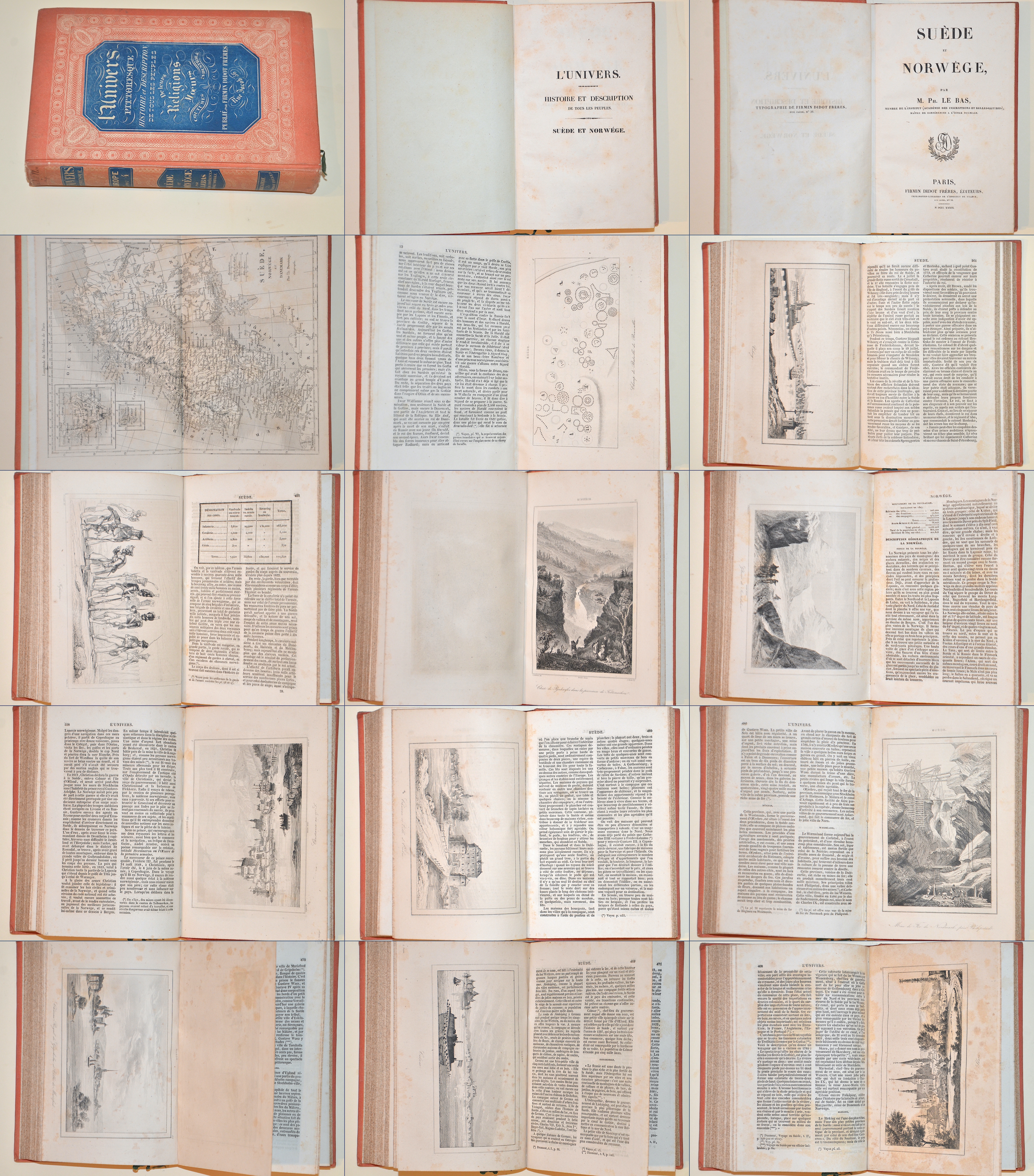
L’Univers Pittoresque Histoire et Description de tous les Peuples De leurs Religions Moeurs. Suede et Norvege par M. Lebas

| Article ID | B0340 |
Title | L’Univers Pittoresque Histoire et Description de tous les Peuples De leurs Religions Moeurs. Suede et Norvege par M. Lebas |
Description | The book describes the history and characteristics of the peoples, their religions, customs, traditions, industries, etc. of Sweden and Norway on a total of 564 pages. Sweden is covered on 502 pages with 48 plates, and Norway on 12 plates. Text in two columns, one map of Scandinavia including Iceland and the Faroe Islands. Minor staining. |
| Year | c. 1839 |
Artist | Frères (c.1790-c. 1840) |
The Didot family were influential in the development of type design and printing. Firmin Didot, one of the prominent figures, was a French printer and typographer, known for developing the Didot typeface in the late 18th century. By 1838, the Didot family, particularly François-Ambroise Didot (Firmin’s nephew), had already solidified their legacy in the printing world. In 1838, Frères Didot (which means "Didot Brothers") was the name under which François-Ambroise Didot and his relatives worked. The Didot printing house was a major force in French typography during the early 19th century. | |
Historical Description | Scandinavia characterized by common ethnocultural North Germanic heritage and mutually intelligible North Germanic languages The term Scandinavia in local usage covers the three kingdoms of Denmark, Norway, and Sweden, but in English usage, it also sometimes refers to the Scandinavian Peninsula or to the broader region which includes Finland and Iceland This broader region is usually known locally as the Nordic countries. The remote Norwegian islands of Svalbard and Jan Mayen are usually not seen as a part of Scandinavia, nor is Greenland, a constituent country within the Kingdom of Denmark. The Faroe Islands may be included. For more than 500 years there was a common ground in the field of foreign policy, from the attack by the Danish king Chlochilaicus on Gaul (517) to the unfortunate move by Harald Hardrades against England in 1066, the Vikings carried out their raids and raids on all European coastal areas, but also deep into Russia stretch. For a long time, another commonality was the rejection of Christianity in times when it had been common in Western Europe for centuries. In addition, the great importance of the Jarle, who were initially only leaders of raids, but as such became very rich and powerful, is characteristic of this period. For this reason, fiefdom in Scandinavia developed much more slowly than in core Europe, and serfdom did not become fully established. In addition to these general similarities, there were also times when several of the Scandinavian countries were united under one rule, such as Denmark, Norway and (more relaxed) Sweden as well as England under Knut the Great from 1028 to 1035, as well as England. Denmark and Norway were soon under the common rule of Magnus the Good from 1042 to 1046. But the main time of the common political development lies in the Kalmar Union, which the countries of Denmark, Norway and Sweden were linked from 1397 to 1523. During this period, Norway lost significant political independence, so that after Sweden left the Kalmar Union with the Danish-Norwegian personal union, there was practically Danish dominance until 1814, which was replaced in 1814 by the Swedish-Norwegian union, which continued until 1905. |
| Place of Publication | Paris |
| Dimensions (cm) | 21 x 14 cm |
| Condition | Binding in hardcover red/blue |
| Coloring | black/white |
| Technique | Feather Lithography |